


Private Label vs Custom Skincare Formulation Which Is Right for You
Starting a skincare line begins with a product decision that shapes almost everything that follows. The formula, packaging, launch timeline, budget, ordering process, brand positioning and customer experience all depend on how the product is developed.
For many founders and professionals, the choice comes down to private label vs custom skincare formulation which is right for you. One path starts with existing professionally developed formulas. The other starts with a product idea and builds the formula from the ground up.
Neither option is automatically better. The right choice depends on what the brand needs to prove, how much control it needs, and how quickly it needs to launch.

What private label skincare means
Private label skincare allows a brand to select from existing formulas that a manufacturer has already developed. The finished products are then sold under the brand’s own name.
Instead of starting with a blank formula, the brand chooses from available product types, such as:
Cleansers
Toners
Serums
Moisturizers
Eye creams
Masks
Exfoliants
Sunscreen products, when offered by the manufacturer
Professional backbar or treatment-support products
From there, the brand usually makes choices around packaging, product names, labels, unit cartons, product assortment and overall presentation.
Private label can be especially useful for dermatology practices, plastic surgery offices, med spas, estheticians, skincare professionals and entrepreneurs who want to start a skincare line without managing a long formula development process for every product.
A good private label skincare manufacturer does more than fill bottles. The manufacturer should offer stable formulas, appropriate packaging options, ingredient information, production support and guidance on what can and cannot be said about the product.
Private label does not mean just putting a label on a bottle
This distinction matters.
A private label product may start with a ready-made formula, but the brand still needs strategy. Choosing a moisturizer, adding a logo and placing it on a shelf is rarely enough to build trust or repeat sales.
A thoughtful private label line still needs:
A clear point of view
A defined customer or patient need
Product names that make sense together
Packaging that fits the price point
Ingredient and usage education
A product assortment that feels complete
Claims that match the formula and comply with regulations
For example, a med spa might build a private label line around post-treatment care, daily hydration and gentle renewal. An esthetician might choose formulas that support dry, sensitive or blemish-prone skin. A founder building an online brand might focus on a tight routine with a cleanser, serum and moisturizer.
The formulas may already exist, but the brand experience still has to be built with care.
What custom skincare formulation means
Custom skincare formulation starts with an idea and turns it into a new product. A brand works with a lab, chemist or custom skincare manufacturer to develop a formula that matches specific goals.
Those goals might involve:
A particular texture
A specific ingredient story
A target skin feel
A fragrance or fragrance-free direction
A unique product format
A specific performance goal
A certain price point
Compatibility with selected packaging
Custom development usually includes several rounds of lab samples. The brand reviews each version and gives feedback. The formula may be adjusted for viscosity, absorption, scent, color, skin feel, ingredient percentage, packaging fit and stability.
This process can create a more distinct product, but it also takes more time, more money and more decision-making.
Custom skincare formulation is often best for brands that need a product they cannot find in a private label catalog. It also makes sense when the formula itself is central to the brand’s identity.

The main differences between private label and custom formulation
Both paths are part of skincare product development, but they work very differently. The table below shows the practical differences that often matter most.
Decision area | Private label skincare | Custom skincare formulation |
Starting point | Existing manufacturer formulas | New formula idea |
Timeline | Usually faster | Usually longer |
Development cost | Usually lower upfront | Usually higher upfront |
Formula control | Limited to available options | Much greater control |
Packaging flexibility | Depends on manufacturer options | Broader, but must be tested |
Product uniqueness | Brand presentation creates distinction | Formula can be more distinct |
Best fit | Faster launch with proven formulas | Original product concept |
Complexity | Lower | Higher |
Private label gives you speed and simplicity. Custom formulation gives you control and originality.
That tradeoff is the heart of the decision.
When private label skincare is the better fit
Private label often works well when the main goal is to launch a professional, polished product line without building every formula from scratch.
It may be the better choice when:
The brand needs to launch relatively quickly
The budget is limited
The product concept fits existing formulas
The founder wants to test demand first
The business already has customers, patients or clients
The brand needs a small but complete product assortment
The team does not have formula development experience
Private label can also reduce early risk. Instead of investing heavily in one custom product before knowing how customers will respond, a brand can begin with a focused set of products and learn from real sales.
For a skincare professional, this can be practical. A client already trusts the provider’s recommendations. A private label line can extend that trust into daily home care.
For an entrepreneur, private label can offer a cleaner path to market. It allows more energy to go toward customer education, packaging decisions, product positioning and operations.
That said, private label has limits. You may not be able to change the active ingredient blend, texture, scent, base formula or product format. If the available formulas do not match the brand vision, forcing a private label product to fit can create problems later.
When custom formulation is the better fit
Custom formulation makes more sense when the product itself needs to be different.
This may be the right path when:
The brand is built around a specific formula concept
A founder wants control over key ingredients
The desired texture or format is not available privately
The product needs to fit a specific packaging system
The long-term strategy depends on product ownership
The brand plans to build intellectual property or unique formulations
Existing private label options feel too generic for the market position
A custom product may help a brand stand out, but only if the concept is clear. “A better serum” is not enough. A custom development project needs direction.
For example, a stronger brief would include the desired customer, skin concern, ingredient preferences, texture target, finish on skin, packaging style, price range and claims direction.
Without that clarity, custom development can become slow and expensive. Each revision costs time. Each new idea can change the formula. Packaging may need compatibility testing. Stability testing may reveal that the formula needs more refinement.
Custom formulation is a strong option, but it rewards preparation.
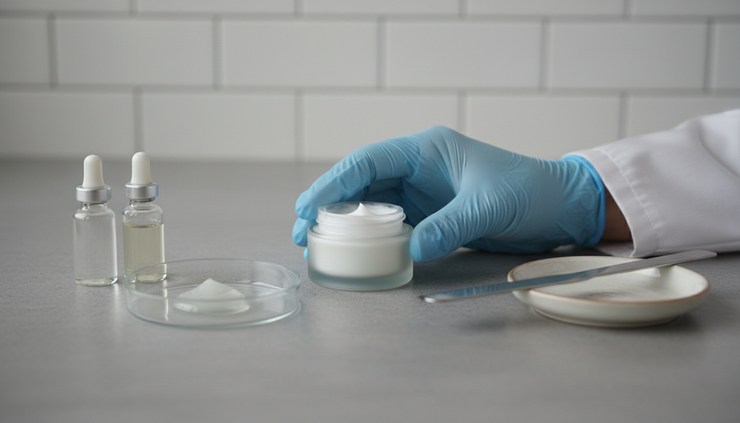
Budget and timeline affect the decision
Budget is not just about the cost of the first production run. It includes development, testing, packaging, design, compliance review, shipping, storage and future reorders.
Private label usually has fewer early development costs because the manufacturer has already created the formula. The largest expenses often involve packaging, label design, minimum order quantities and inventory.
Custom formulation can include costs for lab work, sample rounds, ingredient sourcing, stability testing, compatibility testing and production setup. It can also require more time before the product is ready to sell.
Timeline matters too. A private label launch can often move faster because the formula already exists. Custom products need time for development and testing. Rushing that process can lead to texture issues, packaging problems or formulas that do not feel right on skin.
If the goal is to test a market, private label may be more practical. If the goal is to build a highly specific hero product, custom formulation may be worth the wait.
Brand positioning matters as much as the formula
A skincare line does not succeed on formula alone. Many products fail because the assortment is confusing, the claims are unclear or the customer does not know how to use the products together.
Before choosing a path, define the brand’s core position.
Ask:
What skin needs will the line address?
Will the line feel clinical, spa-focused, minimalist, corrective or luxury?
Will products be sold online, in treatment rooms, in retail or through professional recommendation?
Does the line need three core products or a broader routine?
What claims can be supported responsibly?
What price point will customers accept?
This step helps both private label and custom projects.
For private label, it helps narrow the formula selection. For custom formulation, it gives the chemist a stronger brief.
Skincare also sits in a regulated category. Product claims should be reviewed carefully, especially when discussing acne, aging, pigmentation, sun protection or medical conditions. This article is general business information, not regulatory, legal or medical advice.
How to choose the right development path
The best choice comes from matching the development path to the business goal.
Choose private label if
You want a faster launch, lower development complexity and access to existing professional formulas. This is often a smart first step for practices, med spas, estheticians and founders testing a new concept.
Choose custom formulation if
You need a formula that does not already exist, want greater control over ingredients and texture, and have the budget and timeline for full development.
A practical approach is to start with the least risky path that still supports the brand promise.
Some brands launch with private label first, then develop custom products once they understand their customers. Others begin with one custom hero product and use private label products to complete the routine. Both models can work.
The mistake is choosing based only on pride or speed. A custom formula is not automatically better. A private label product is not automatically generic. Quality depends on the manufacturer, formula, packaging, claims, education and how well the product fits the customer.
Questions to ask before choosing a manufacturer
The manufacturer relationship can shape the success of the entire launch. Before committing, ask clear questions.
For private label projects, ask:
What formulas are available?
Can samples be reviewed before ordering?
What packaging options are compatible?
What are the minimum order quantities?
What ingredient and claim support is provided?
What is the reorder process?
Can the line grow over time?
For custom projects, ask:
How many lab sample rounds are included?
Who owns the final formula?
What testing is required?
What packaging compatibility work is needed?
How are ingredient changes handled?
What happens if a formula fails stability testing?
What production quantities are required?
The answers will reveal how organized, transparent and realistic the manufacturer is.

The right choice is the one that fits the brand stage
Private label and custom formulation serve different needs.
Private label skincare is often the better fit when speed, simplicity and lower early risk matter most. It allows a brand to launch with established formulas and focus on presentation, education and customer experience.
Custom formulation is often the better fit when the formula must be original, the brand needs specific performance or texture goals, and the budget allows for a longer development process.
A clear decision starts with honest questions. What needs to be unique right now? What can be proven with existing formulas? What budget is available? How soon does the line need to launch? What will customers actually value?
The best skincare line is not the one with the most complicated development story. It is the one built around products that make sense, feel good to use and support a clear brand promise.



Comments